

Too often, a small, dedicated group of individuals grapples with Process Safety Management (PSM) and MI while struggling to embed these programs deeply into the company culture. The true challenge lies in transforming MI from a checklist item into a fully embraced, organization-wide commitment that drives safety,reliability, and profitability.
The First Problem: What is an MI Program?
A significant barrier to successful MI program implementation is the lack of consensus on what MI actually means:
- Is it just a list of due and overdue inspections?
- Does it involve opening every asset during maintenance turnarounds for internal inspections?
- Or is it about implementing a comprehensive Risk-Based Inspection (RBI) program?
Mechanical Integrity is a holistic approach ensuring the safe, reliable operation and maintenance of critical assets. While the specifics may vary, MI fundamentally focuses on the proper design, installation, operation, and maintenance of equipment to prevent failures and ensure safety.
Why #1: External Regulation
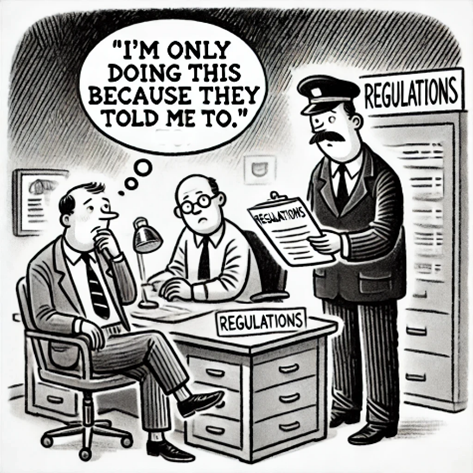
Often the simplest “why” is that “someone told me to do it”. This approach mirrors our early compliance experiences with parental guidance, where we followed instructions (“regulations”) even without understanding the reasoning or believing it will improve our life in some way. Similarly, some may react to Mechanical Integrity (MI) regulations with resistance or indifference, just checking the boxes to stay out of trouble.
Globally, regulations and standards exist, including Canada's CSA Z767, which focuses on the procedural aspects of MI, the UK's COMAH regulations, which are enforceable regulations, and international standards like ISO 45001. Combining these documents, especially when enacted as federal regulations, with local state/provincial rules, often is enough to compel organizations to establish and maintain some form of MI program. In the US, external regulations such as OSHA 29 CFR 1910.119 and 40 CFR 68 mandate compliance from most operators, providing comprehensive guidance on various aspects of process safety management (PSM), including MI. It is a standard expectation in US operating facilities to have a PSM (and MI) program that is subject to both internal and external audits.
So, this means that you now have people in your organization that have some accountability to MI-related metrics and likely report on these with some frequency. In many cases this is added into other Safety and Quality metrics and managed by your HSE department.
Compliance driven by external mandates can spur activity, but it often leads to the bare minimum level of adherence, failing to foster meaningful organizational change. A small group of passionate individuals cannot necessarily drive overall improvement if the broader company culture is reactive and focused solely on daily business operations.
Why #2: Do it because it helps drive your business
“A Mechanical Integrity Program is a documented system that provides for the inspection, testing, and maintenance of equipment to ensure that it operates safely and reliably.” – California Accidental Release Prevention (CALARP)
Reliability in operations is often touted as "just good business." Rather than debating this, let’s examine (from a very high level) the mathematics behind it. For most businesses in the oil & gas, chemical, power, and similar processing industries, revenue is derived from a simple formula:

Price can often be set by the market unless you can make a case for premiums through differentiation, etc. The (# of units) at the simplest level, is a function of your processing capacity and with a few simple considerations can be described as:

Units/Time represents the nameplate capacity of your processing unit. Increasing this often requires capital investment or operational increases “above” nameplate that can have additional integrity impacts. Uptime, is possibly the first place where MI personnel (and a robust MI program) can make a significant impact on the economics of an operation or can at least lead to more predictable outcomes. We can reduce the amount of unplanned downtime through predictive and proactive activities (inspection, etc.) and optimize the planned downtime through better planning and scope control (eg. RBI, online inspections, etc.).

For example, consider a year where you have 30 days of planned shutdown and have 10 cumulative days of events that lead to unplanned stoppages of your units:

Thus, at best, you can only achieve 89% of your processing capacity. While storage/tankage solutions can mitigate some uptime issues and add a “+ stored units” to the above equation, the processing for that tankage capacity still has to come from reliable operations. So, what about the cost side? After all, businesses like ours are generally about generating profit, not just revenue. In the simplest form, and something I’m sure will make the production folks cringe in its overt simplicity, cost is:


While this could be further refined into fixed and variable costs, the point is that mechanical integrity efforts can operate directly on the Inspection/Maintenance/Reliability bucket as well is creating some predictability in asset depreciation (which is a function of asset life to some extent). Putting all the math together, we can define profit from our equations above: Revenue - Cost.
A well-executed MI program enhances reliability and reduces operational risks, leading to consistent and predictable profits. By optimizing maintenance and inspection schedules, companies can maximize uptime and reduce unexpected outages. The focus on maintaining high reliability translates directly to financial stability and reduced costs associated with equipment failures and downtime. Another important cost consideration that many operators overlook is the impact on insurance expenses. By demonstrating control over asset integrity through an effective MI program, evidenced by increased uptime and reduced unplanned incidents, you can often achieve significant reductions in insurance costs.
Why# 3: Integration and Consolidation
This initiative should be considered a Driver #2+ as it focuses on developing a standardized MI program across multiple sites or units, promoting alignment and consistent decision-making within an organization.
- Creating Common Language: Establishing a shared vocabulary is essential for alignment within an organization, particularly for multi-site companies. A strong MI program become part of the culture when deployed effectively across facilities.
- Standardizing Processes: Implementing uniform processes ensures consistent decision-making and goal-setting across different units, plants, and facilities.
- Developing Proactive KPIs: Focus on key performance indicators that measure success proactively rather than reactively. This shift is crucial for long-term improvements. Many owner/operators currently emphasize lagging indicators (e.g., revenue, profit, downtime, leaks). The goal is to transition towards predictive indicators, such as risk reductions, planned inspections, and inspection “finds”.
Why# 0: Safety
Safety is the paramount driver for MI programs (and PSM in general). While it is listed last in this article, it is generally accepted to be the primary focus for most operators. The challenge is often the link between MI activities (inspections, planning, evaluation, repairs, etc.) and safety is not always obvious. Ensuring the protection of employees, the community, the investment in assets, and the environment is crucial.
Predictability and consistently keeping the hazards on the right side of the steel through regular and proactive interventions not only keeps people safe but also goes back to reducing lifecycle costs.
Conclusion
Implementing a robust Mechanical Integrity (MI) program is vital for the safety, reliability, and profitability of industrial operations. While defining MI might initially be challenging, understanding its comprehensive scope is essential. MI is not merely about compliance or checklists; it’s a holistic approach that ensures equipment performs reliably and safely throughout its lifecycle.
The benefits of an effective MI program extend beyond regulatory compliance. Enhanced reliability, reduced downtimes, and financial stability are just a few of the advantages. Standardizing MI practices across sites fosters alignment and improves decision-making, while the ultimate goal remains the same: safety. Protecting employees, the community, and the environment is paramount, and a strong MI program is a cornerstone of that commitment.
By embracing MI as an integral part of your organization's culture, you not only ensure compliance but also drive continuous improvement, operational excellence, and long-term success.